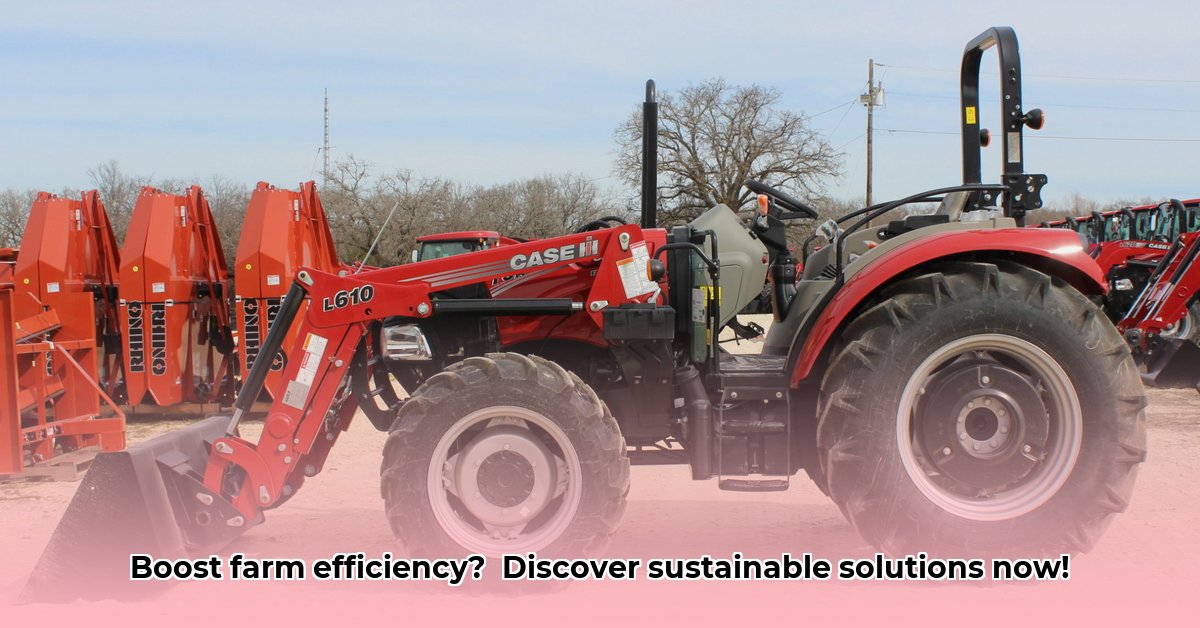
Case Loader Tractor: Boosting Farm Efficiency and Sustainability
The Case IH L610 loader represents a significant advancement in agricultural technology, promising to revolutionize bale handling and enhance overall farm efficiency. This article delves into the technical capabilities of the L610, analyzes its contribution to sustainable farming practices, and explores its potential return on investment for farmers. For more on Case equipment, check out this helpful resource.
The Case IH L610: A Workhorse with Muscle
The L610 boasts a substantial lift capacity of up to 3,153 pounds, easily handling even the largest and densest bales. Its impressive reach of 120 inches minimizes awkward maneuvering, maximizing productivity and reducing operator fatigue. The versatility of the L610 is further enhanced by a range of available attachments, including the Bale Spear, Deluxe Square Bale Fork, and Heavy Duty Bale Grip, catering to diverse bale types and handling scenarios. Isn't efficient bale handling a key to maximizing profitability?
Bale Handling: Saving Time and Money
The L610 dramatically reduces the time spent on manual bale handling. This translates to significant cost savings through reduced labor expenses and increased operational efficiency. The exact financial benefits vary depending on factors like farm size and existing labor costs, but the potential for a strong return on investment is undeniable. How much time do you currently spend on manual bale handling? Could that time be better spent elsewhere on the farm?
Sustainability: A Work in Progress
While the L610's efficiency gains contribute indirectly to sustainability by reducing fuel consumption through fewer passes, comprehensive data on fuel efficiency and greenhouse gas emissions are still needed. The reduced need for multiple passes with multiple fuel-intensive machines suggests potential environmental benefits, but further research is necessary to quantify this impact fully. How can we gather data to provide a complete picture of the L610's environmental footprint?
Improving Sustainability: The Future of Farm Technology
To fully unlock the L610's sustainability potential, several key improvements are needed:
Fuel Efficiency Enhancements: Case IH should explore the use of lighter materials and optimized hydraulic systems to improve the loader's fuel efficiency. This is vital for reducing its environmental impact.
Comprehensive Data Collection: It's crucial to gather accurate fuel consumption data under various operating conditions to obtain a holistic understanding of environmental impact.
Full Lifecycle Assessment (LCA): Conducting a comprehensive LCA, covering the entire product life cycle from manufacturing to disposal, will provide a more complete picture of the environmental implications. This is a critical step towards more transparent sustainability evaluation.
Return on Investment (ROI): Making Sense of the Numbers
The L610's significant upfront cost is offset by the potential for substantial ROI. Reduced labor costs and increased output are the primary drivers of this return. Precise ROI calculations require a detailed analysis tailored to each individual farm, considering specific factors like farm size, bale type, and labor costs. What are your specific labor costs, and how might the L610 impact them?
Challenges and Next Steps: Where We Go From Here
While offering significant advantages, the L610's potential for enhanced sustainability is still evolving. Continued research is critical to understanding its long-term environmental impact, particularly regarding fuel consumption. Collaboration among farmers, Case IH, and research institutions is vital to address these challenges and drive further innovation.
Key Takeaways:
- The Case IH L610 loader offers significant improvements in farm efficiency via enhanced bale handling.
- While indirect sustainability benefits are evident, further data is needed to fully quantify its environmental impact.
- A robust ROI is achievable, although a farm-specific analysis is recommended.